










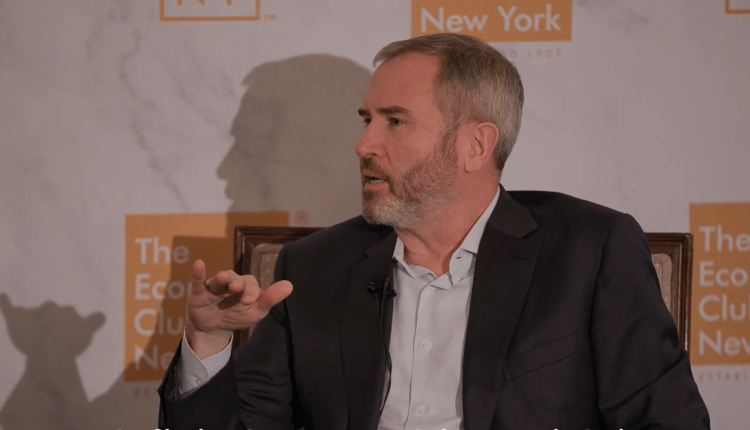
Ripple CEO Brad Garlinghouse sidestepped a direct question about whether the company would ever buy a bank, using the moment instead to restate Ripple’s institutional-first strategy and argue that clearer US rules are already unlocking demand for stablecoins and XRP Ledger based payments.
Speaking with James Hasso at the Economic Club of New York on Feb. 18, Garlinghouse was asked whether Ripple might acquire a bank outright or lean into tighter partnerships as it works with large financial institutions and builds out its stablecoin business.
“I’m going to dodge part of your question answer,” Garlinghouse said, before pivoting into why Ripple has historically embraced banks rather than positioning itself against them.
What Is Ripple’s Plan?
Garlinghouse framed Ripple’s posture as deliberately contrarian relative to early crypto culture. “Ripple took a contrarian and controversial strategy approach to how we went to market early on and that made us unpopular in crypto,” he said. “Early on Ripple said banks are our customers. If we want these technologies to have the biggest impact on the largest number of people, banks are the touch point for people in their financial services relationships.”
He contrasted that with what he described as crypto’s initial instinct to build outside the existing system. “The earliest days of crypto was a very anti-bank anti-government uh let’s build a parallel universe,” Garlinghouse said. “Ripple always took the point of view that we’re going to be a bridge between what we would now call tradfi or traditional finance and defy decentralized finance.”
That bridge-building claim also anchored his response on Ripple’s regulatory posture around its stablecoin business. Garlinghouse said Ripple launched RLUSD 13 months ago and claimed it now sits “about number five” among the largest stablecoins—an outcome he linked to leaning into oversight rather than avoiding it.
Garlinghouse highlighted a New York Department of Financial Services trust license and a conditional OCC charter, characterizing the latter as “belt and suspenders” for the stablecoin business. “We think that uniquely positions us as you know almost overregulated,” he said.
“But we want that…because we work with institutions we want them to look at us as going above and beyond to make sure there is that level of oversight so there’s no questions…is the stablecoin backed one to one [and]…the attestations on a regular basis about those backings.”
Then came the cleanest non-answer of the session. “And I’m going to skip the question, will we ever buy a bank? They are customers,” Garlinghouse said.
Pressed on whether additional US legislation could accelerate adoption, Garlinghouse pointed to an earlier example: “The Genius Act was the stable coin legislation that passed…President Trump signed it either at the end of July or early August,” he said. “That was an unlock for sure…we definitely saw a big uptick in stablecoin activity after that became law.”
He argued a similar effect could follow if the Clarity Act passes, because clearer definitions would give boards, CFOs, and banks more room to move. For corporates, he emphasized operational utility—especially “24/7 ability to move” stablecoins—arguing that “being able to make a payment on a Sunday afternoon sometimes is important.”
Garlinghouse said Ripple has kept its commercial center of gravity on payments because the value proposition is straightforward: faster, cheaper settlement. On tokenization, he was supportive but selective, noting friction in traditional settlement cycles like “T+3” and “T+1,” while also warning that some projects feel like “a technology in search of a problem.”
He pointed to BlackRock CEO Larry Fink as a prominent advocate, saying Fink believes a “huge percentage of assets will be tokenized,” and added: “I agree with him.” But Garlinghouse stressed that execution will be “vertical by vertical,” arguing domain experts, not Ripple, need to drive sectors it doesn’t understand, like insurance.
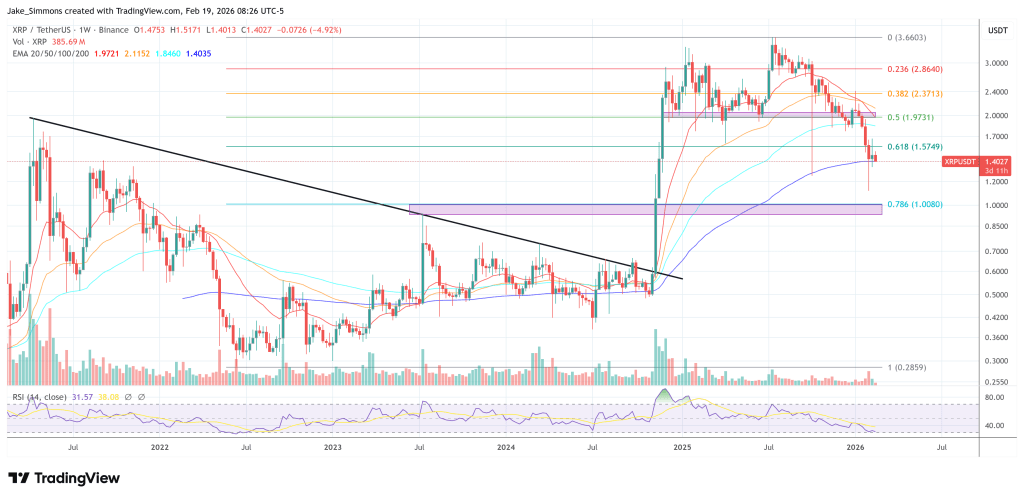
At press time, XRP traded at $1.4027.










+ There are no comments
Add yours