










Bitcoin’s recent wobble has traders on edge, but the picture is not all one-way. Reports note heavy losses for late buyers, and on-chain figures show real money changing hands as positions are forced closed. Markets moved fast; the mood did too.
Fear And Greed Plunges To Single Digits
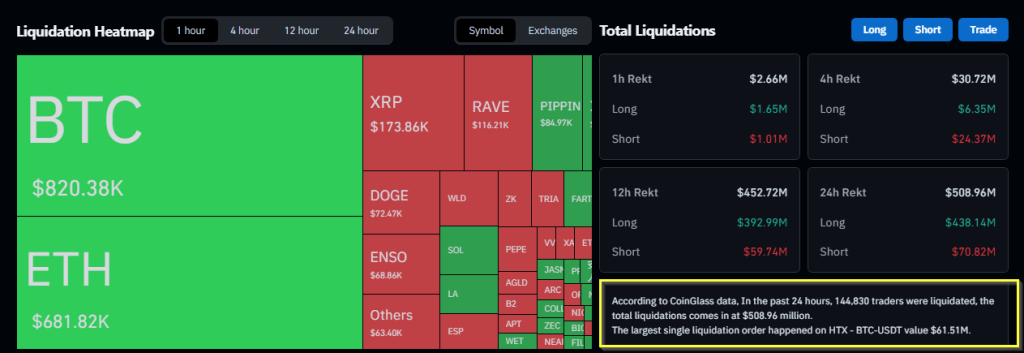
According to CoinGlass, more than 144,839 traders were liquidated in the last 24 hours, with total liquidations of over $508 million and about 92% tied to long bets.
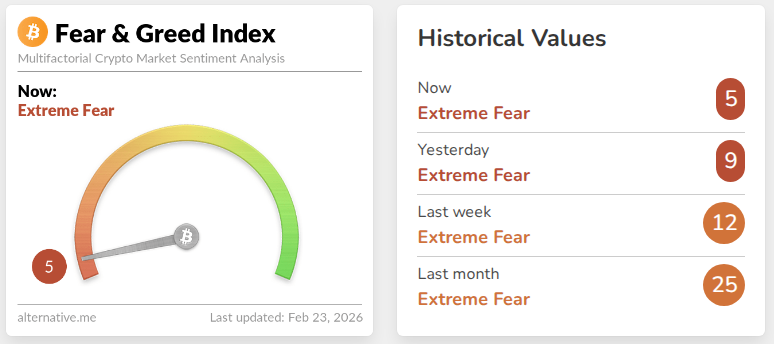
Reports from Alternative.me put the Crypto Fear and Greed Index at 5 out of 100 — a reading that has turned up only three times since 2018.
That level screams panic. Yet panic often clears out the most fragile holders and leaves room for steadier hands to step in.
Realized Losses And Capitulation Signals
Based on reports from Glassnode, recent investors are still booking losses at a high rate — the seven-day moving average for net realized losses was close to $500 million per day.
That kind of selling pressure looks brutal on a chart. At the same time, selling at scale can mark an end to a sharp phase of decline, because it reduces the number of people left to sell when prices fall further.
Bitcoin Price Action
In the middle of all this, price moves matter. Bitcoin rose to roughly $68,600 on Saturday, but it slid back and touched the mid-$64,000s after a wave of exits.
Traders are watching a range that formed after the early-February drop to about $60,000. The coin remains roughly 48% below an October high of $126,000 and about 5.5% under the 2021 peak near $69,000.
News tied to US-Iran tension and general risk-off trading pushed some traders toward safer assets, which added fuel to the pullback.
Sharpe Ratio Hits Unusual Low
Analyst Michaël van de Poppe shared a chart showing Bitcoin’s Sharpe Ratio at -38.4. That metric measures returns relative to risk; a number this low is rare.
This is a phenomenal chart.
It shows the Sharpe Ratio for #Bitcoin in the short term.
The key takeaway: the Sharpe Ratio has dropped to -38.38, which historically has marked “Low Risk” accumulation zones. The red circles highlight every time the Sharpe Ratio dipped to similar… pic.twitter.com/Nwp7SkfVP4
— Michaël van de Poppe (@CryptoMichNL) February 21, 2026
Historically, extreme negative readings have sometimes lined up with moments when buying risk felt lower, because potential downside had been squeezed out by big selloffs.
That does not guarantee a rebound, but it changes how investors view the trade-off between reward and risk.
Where This Could Lead
Some technical watchers warn that more tests of support could happen if uncertainty continues. Others point to the combination of heavy liquidations, deep fear readings, and large realized losses as signals that a base might be forming.
Pasts on-chain figures show that panic and steep losses often precede quieter periods where buyers return slowly.
Featured image from Unsplash, chart from TradingView






+ There are no comments
Add yours