










Ethereum is struggling to reclaim the $3,100 level as price action tightens and the market braces for a decisive move. After weeks of choppy trading, ETH remains caught between fading bullish attempts and persistent overhead resistance, leaving analysts sharply divided on what comes next. A minority still expects Ethereum to regain strength and eventually challenge its all-time highs, while the dominant narrative points toward a bearish 2026 marked by weaker demand and tighter liquidity conditions.
Amid this uncertainty, a CryptoQuant report offers a longer-term perspective that cuts through short-term noise. The analysis focuses on Ethereum’s Accumulating Addresses Realized Price, a metric that tracks the average cost basis of addresses that consistently accumulate ETH rather than trade it actively. Unlike momentum indicators, this measure reflects where long-term participants are willing to commit capital over extended periods.
Notably, this accumulation cost has trended steadily higher since 2020. Even during the severe 2022–2023 drawdown, when ETH price corrected sharply, long-term holders largely held their ground instead of capitulating. That behavior established a durable foundation beneath the market.
Today, this realized price has stabilized in the $2,700–$2,800 range, effectively forming a structural cost zone for Ethereum. As ETH hovers just above this area, the market faces a critical question: whether this long-term support continues to anchor price, or if shifting macro conditions finally challenge a regime that has held for years.
Ethereum Long-Term Accumulation Regime Faces a Critical Test
The report argues that the debate around Ethereum is shifting. The key issue is no longer whether the $2,700–$2,800 accumulation zone holds in the short term, but whether this long-standing accumulation regime can persist indefinitely. According to data from CryptoQuant, Ethereum stands out sharply from the broader altcoin market when viewed through this lens.

Since 2022, most altcoins have suffered deep drawdowns without ever forming a durable accumulation cost base. That absence of consistent long-term buying helps explain why recoveries across the altcoin complex have been weaker and more fragile. Ethereum, by contrast, has repeatedly demonstrated an ability to retain long-term holder conviction through multiple stress periods, including 2018, 2020, 2022, and even the volatility seen in 2025.
However, markets evolve, and structural regimes do not last forever. Periods of apparent stability are often when underlying assumptions are most vulnerable to change. From a forward-looking perspective, two scenarios stand out.
As long as ETH price trades near or above its accumulation cost, it signals that long-term buyers remain engaged, reinforcing Ethereum’s relative resilience compared with most altcoins. On the other hand, a sustained break below this cost zone would imply a meaningful behavioral shift among long-term holders—one that could challenge the idea that Ethereum has permanently escaped its pre-2020 valuation framework.
In today’s environment, short-term price swings dominate attention, but it is this structural battle beneath the surface that may ultimately define Ethereum’s next major cycle.
Price Consolidates as Bulls Defend the $3,000 Zone
Ethereum is currently consolidating around the $3,100 level after failing to reclaim higher resistance zones, reflecting a market caught between stabilization and continuation risk. The chart shows ETH trading below its short- and medium-term moving averages, with the 50-day and 100-day averages now acting as dynamic resistance rather than support. This shift confirms that the broader structure remains corrective following the rejection from the $4,000–$4,200 region earlier in the cycle.
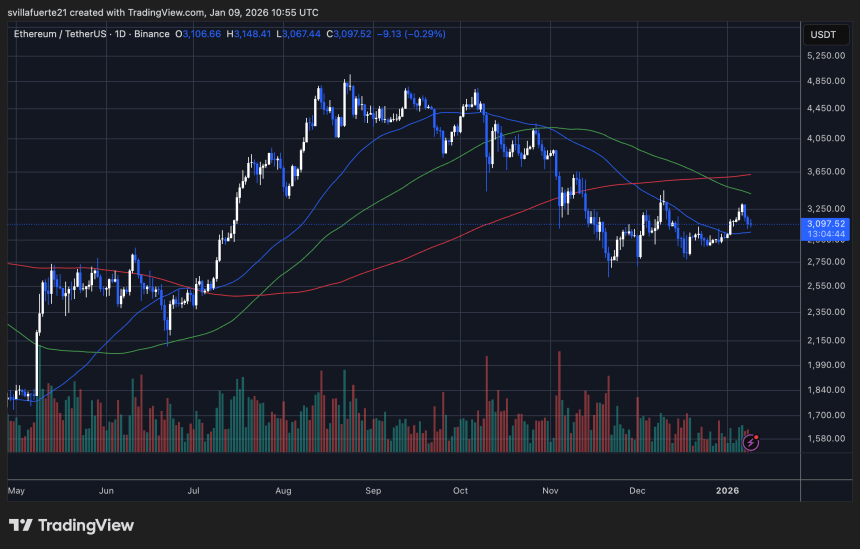
Notably, the $3,000–$3,100 area has emerged as a critical pivot. Price has repeatedly defended this zone, suggesting the presence of demand and short-term accumulation. However, upside momentum remains limited, as each bounce has been met with selling pressure near descending moving averages. This behavior is typical of markets attempting to form a base after a prolonged drawdown rather than initiating a clean trend reversal.
From a structural perspective, ETH remains above the long-term moving average, which continues to slope upward. This indicates that the broader macro trend has not fully broken down, even though short-term momentum is weak. Volume has also declined during recent rebounds, reinforcing the idea that buyers lack conviction.
For bulls, a sustained reclaim of the $3,300 level would be required to shift momentum and challenge the bearish structure. Until then, Ethereum appears locked in a consolidation phase, with downside risks persisting if the $3,000 support fails to hold.
Featured image from ChatGPT, chart from TradingView.com











+ There are no comments
Add yours